The India T20 World Cup 2026 squad has been officially unveiled by the Board of Control for Cricket in India (BCCI), ahead of the marquee tournament co-hosted by India and Sri Lanka in February–March 2026. The selection has sparked widespread discussion, especially due to some high-profile exclusions and intriguing inclusions.
India T20I 2026 world cup captain and Key Decisions
The Indian selectors have shown clear intent with this squad, backing continuity in leadership while also rewarding recent performances. Suryakumar Yadav continues as captain after consistent displays in the shortest format, while Axar Patel has been entrusted with the vice-captaincy role. The think tank appears focused on maintaining balance rather than relying solely on reputation, which explains some bold calls in the final list.
Full India T20 World Cup 2026 Squad
Here’s the 15-member India T20 World Cup 2026 squad announced by the BCCI:
Sanju Samson (WK) – Wicketkeeper and flexible top-order option
Ishan Kishan (WK) – Recalled after strong domestic form
Abhishek Sharma – Explosive top-order batter
Tilak Varma – Young batting talent
Rinku Singh – Hard-hitting middle-order batter
All-Rounders
Hardik Pandya – Seam-bowling all-rounder
Shivam Dube – Power-hitting all-round option
Axar Patel (Vice-Captain) – Spin all-rounder
Washington Sundar – Match-up utility all-rounder
Bowlers
Jasprit Bumrah – Lead pace spearhead
Arshdeep Singh – Left-arm speedster
Kuldeep Yadav – Wrist spinner
Varun Chakaravarthy – Mystery spin weapon
Harshit Rana – Seam bowling depth
Squad Composition Explanation
India’s squad for the T20 World Cup 2026 reflects a modern T20 approach, blending aggressive batters, flexible all-rounders, and specialists suited for pressure situations. The presence of multiple batting options in the middle order offers depth, while the bowling unit includes variety through pace, swing, and spin. This combination gives the team flexibility to adapt across venues and match scenarios.
Notable Exclusions
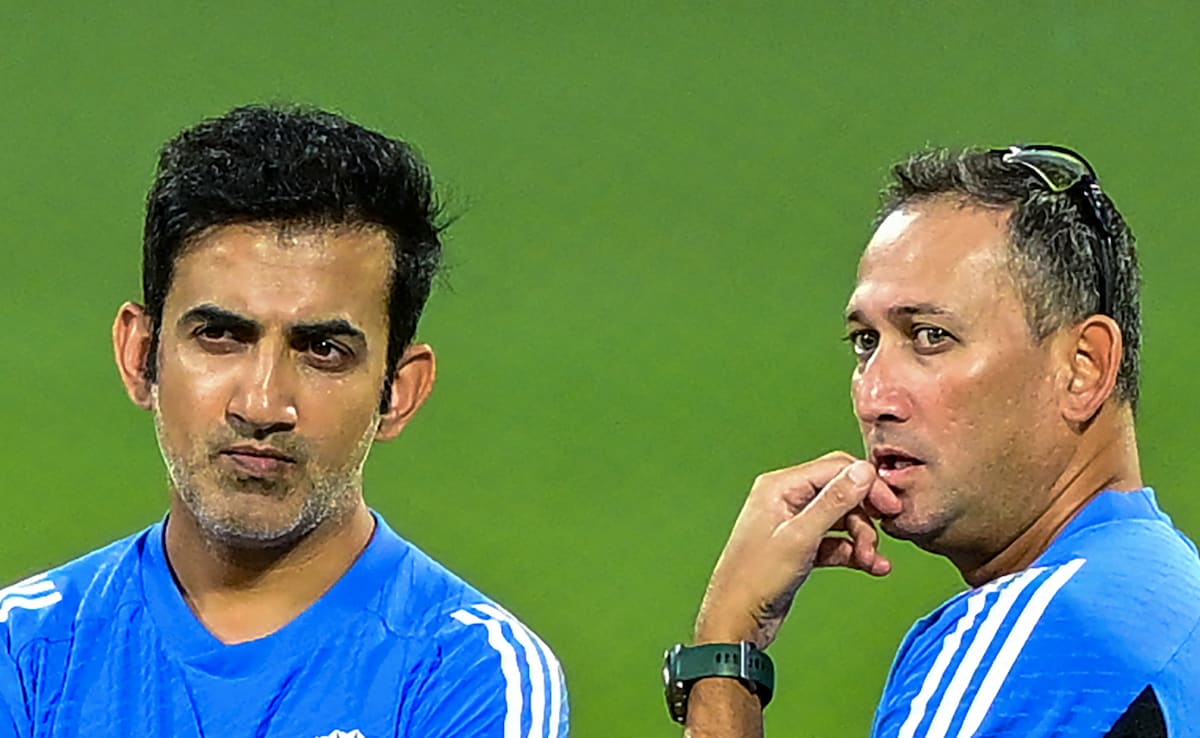
The removal of Shubman Gill, who had been vice-captain in recent Twenty20 Internationals, is one of the most talked-about aspects of the squad announcement. Gill’s lack of form and the selectors’ emphasis on team balance led to his exclusion. Chief selector Ajit Agarkar acknowledged the decision at the press conference, emphasizing that the selections were based on recent performance and combinations.
Another surprising omission is Jitesh Sharma, who missed out despite featuring in recent T20I series. His spot opened up opportunities for Ishan Kishan and Rinku Singh.
Strategy and Outlook of India in T20I WC 2026
India’s team combines young players like Tilak Varma and Rinku Singh with seasoned players like Bumrah and Pandya. Samson and Kishan, the two wicketkeepers, offer flexibility in batting orders and squad configurations.
With home advantage and a well-balanced team built to handle a variety of match conditions across sites, India will start its World Cup campaign with high hopes.
Two white washes for India in the Test series at home against New Zealand and South Africa have raised the eyebrows of Indian cricket connoisseurs. Former players, sports journalists, and fans have come together, holding chief coach Gautam Gambhir and his staff, along with the selection committee headed by Agarkar, accountable for this dismal performance by the Indian Test squad. More than just the loss of the Test series in India, it was the team’s lacklustre effort that left them all deeply disappointed.
For years, Test cricket in India was synonymous with inevitability. Opposition teams arrived like tourists, endured a trial by spin, and left quietly. But the recent series against New Zealand and South Africa shattered that aura. In familiar conditions, on pitches designed to favour them, India were not just beaten — they were outclassed, outthought, and outlasted.
Pic Credit : The Hans India
On pitches offering assistance to spinners, India’s batters, playing in home conditions, were expected to dominate. Instead, they looked hesitant against the turn and bounce, trapped between attack and defence, neither fully one nor the other. Their approach was vague, shot selection indecisive, and intent confusing.
While the batsmen of previous generations turned to defence as a weapon, many batters on this side appeared uncomfortable with restraint. Test cricket demands patience, and that patience was conspicuously lacking.
Similar to the batsmen, the bowlers failed to utilise the advantageous conditions, and the visitors handled the Indian spinners without any difficulty.
Were the selectors and team management mistaken in transitioning away from senior players and opting for a fresh squad? An analysis of the performances of veterans such as Rohit, Kohli, and Ashwin against New Zealand and Australia recently supported the choice to revamp the Test team, considering the upcoming WTC.
Pic Credit : The Tribune
Did the selectors choose the Test team based on a player’s IPL performance? Indian cricket has a notable history of players who have flopped on the international stage after shining in first-class cricket, and the IPL allows Indian selectors to see how emerging talent might fare against international competitors. For example, the extra split second which Sai Sudharsan had, and his technique while playing real quick bowlers in the IPL, should have clinched him a spot in the Indian A team ahead of many others who scored in the IPL and first-class cricket.
Did the selectors make frequent changes to the team lineup against South Africa? Nitish Kumar Reddy, who performed well in Australia, returned to the squad along with Pant after both had recovered from injuries. Jurel, who excelled as a batsman against England and West Indies, was included as a specialist batsman against South Africa following his consecutive centuries against South Africa A. Sai Sudharsan and Devdutt Padikkal were retained alongside Axar Patel.
Pic Credit : Business Standard
So, what exactly went wrong? There isn’t a clear answer to this inquiry, and we can only outline several potential reasons as listed below.
The IPL offers a chance for foreign players to familiarise themselves with Indian pitches, effectively eliminating the element of surprise that used to affect visiting teams.
Several Indian players participated in limited-overs cricket in Australia prior to the series against South Africa, which could have impacted their performances in the Test matches.
Indian stand-in captain Pant struggled in his role both as a leader and as a batsman, which may have impacted the team’s morale.
Indian batsmen seemed to overlook their preparation, given the well-known Indian pitches, and did not train as thoroughly as they did during their tours to Australia and England.
Test cricket is as much a psychological battle as it is a physical one, with self-belief being vital for achieving success. This Indian team appeared to be missing both the confidence and the determination to battle through, contrasting with their performance in England.
India’s defeat will sting, and it should. A home series loss is not merely a result; it is a signal. But it can become a turning point if acted upon with a vision.
Quoting Sidhuism, “When you fall on your backside, the only place you can look is up”, this Indian Test team can only improve. As Shubman Gill evolves in his role as a leader, and with some strategic changes and adjustments supported by situational practice ahead of a series, this Indian Test squad has the potential to rebound and regain its former prestige.
Knee-jerk reactions are not the need of the hour. Continuity is the key. Don’t write this team off. India does not need a reinvention of identity. It simply needs to rediscover the one it built greatness on, and it is only a matter of time.
Webinars in February 2026: Sessions for grassroots clubs
Running a grassroots club means juggling a hundred moving parts, including memberships, payments, comms, admin, and (somehow) still finding time to enjoy the sport.
That’s exactly why we’re running a short series of live webinars this February: three focused, practical sessions designed to help club decision makers, volunteers and admins get more value from Pitchero, and get your questions answered along the way.
Each webinar is free, delivered live by our team, and includes a Q&A. And if you can’t make the session live, register anyway,we’ll send the recording afterwards.
In the summer of 2007, my family moved to the United States. I was ten and had spent the previous three years playing cricket for my school in Mumbai. Cricket was the dream, and life revolved around it.
In Oklahoma, that structure simply did not exist. There were no school teams, no coaches, and no obvious place for a young cricketer to develop.
It became just my brother and me, sometimes joined by a couple of friends, playing makeshift Test cricket on a basketball court in the neighborhood park.
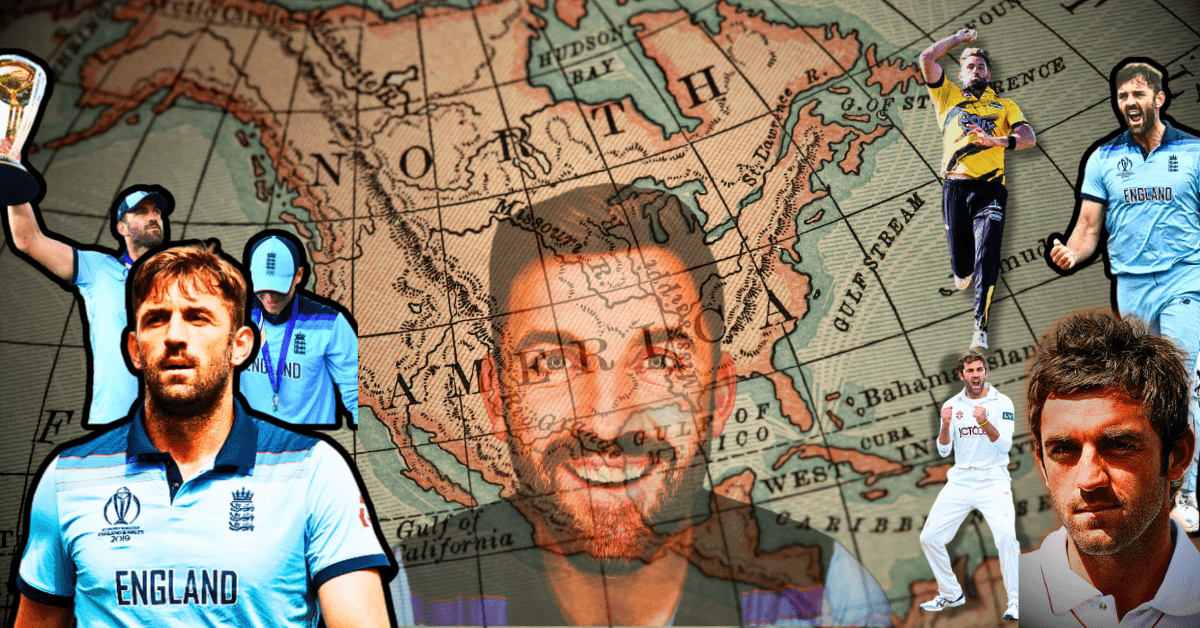
That absence is why Liam Plunkett’s work in America is worth paying attention to.
This piece looks at the second act of World Cup winner Liam Plunkett. No longer just a cricketer, he is now also a coach, commentator, businessman, and one of the driving forces behind grassroots cricket in the United States.
Embed from Getty Images
What Cricket in America is Missing
Investors often view the United States as a potential goldmine for cricket. Critics, on the other hand, point to administrative issues within USA cricket and dismiss the American market as a hopeless cause.
Both views hold some truth. The reality sits somewhere in the middle.
The launch of Major League Cricket (MLC) four years ago, the construction of new stadiums, and the arrival of international names such as Corey Anderson and Liam Plunkett helped jumpstart the conversation. Club cricket is already well established across major metropolitan areas, driven largely by expatriate communities. Journeys like Avinash’s in Iowa show the range of competitions that exist within American college and club cricket.
Yet two important pieces are still missing: cricket as an official NCAA college sport and genuine grassroots structure for young players.
Plunkett’s path toward addressing this imbalance began long before America entered the picture.
Embed from Getty Images
Liam Plunkett’s First Act
Liam Plunkett began his County career with Durham in 2003, shortly after turning eighteen.
He broke through quickly, taking 50 wickets in the 2005 season and earning an England call-up soon after that 2005 Ashes. County success followed, including a starring role in the 2007 Friends Provident Trophy and back-to-back County Championship titles in 2008 & 2009.
His international career, however, was far less linear. After his first stint with England in 2006-07, he went nearly seven years without a sustained run in the national side. Even then, he was a valuable contributor, an exceptional fielder and also featured in England’s highest 9th wicket ODI partnership with super-sub Vikram Solanki in just his 2nd ODI.
Things changed after 2016.
Plunkett re-emerged as a permanent fixture in England’s white-ball teams, first at the 2016 T20 World Cup, and then more decisively in ODI cricket. From 2016 to the 2019 ODI World Cup Final, he took 90 wickets in 53 innings at an average of 27.02, establishing himself as one of the game’s most reliable middle-overs bowlers.
He played a defining role in England’s 2019 World Cup win, finishing the tournament with 11 wickets. His spell of 10-0-42-3 in the final removed Kane Williamson, Henry Nicholls, and Jimmy Neesham, keeping England in the contest. Not to forget the 17-run crucial partnership with Ben Stokes in the tense chase.
Plunkett’s first act was shaped by adaptation, finding a role, refining it, and remaining relevant.
Dropped, But Not Done
As it would turn out, the World Cup Final was his last appearance in an England jersey. At the peak of his powers, Liam Plunkett was dropped with little communication. In his own words, “disappointment is an understatement.”
The pandemic soon followed, bringing international cricket to a halt. For a time, it was easy to assume that his career was over.
Then began the second act.
Plunkett’s wife is American, and Philadelphia had long been familiar territory. He spent a few months there each year even before his England exit. After the axe, he began playing Minor League with the Philadelphians, a team with deep historical ties to the American game.
When Major League Cricket followed, Plunkett became affiliated with the San Francisco Unicorns. What initially looked like a farewell began to resemble a transition instead.
Embed from Getty Images
America as Opportunity, Not an Exit
Three years on, Plunkett is still playing in MLC, with at least one more professional season left in him. America has helped him to branch out further.
In an episode of Under the Lid by The Cricketer, Plunkett spoke how his involvement with the game has expanded well beyond playing. This has taken several forms:
When Plunkett signed for MLC, his role was not limited to playing in the Minor League and Major League. It also included a stint as a national development coach and coaching at the local academy level. That exposure made one gap impossible to ignore.
“In terms of the coach education, it never was there…And it sparked like…Why is there not a platform to coach coaches, to coach kids properly?…It’s our job to get kids strong and fit to complement their cricket skills…We want to help make cricketers healthy and fit, not just for cricket but also outside of cricket, healthy, faster, and stronger.”
– Liam plunkett
LPC is built around that gap. The focus is not only talent, but structure, helping young players learn correctly, and helping coaches learn how to teach.
Now in the US, Liam Plunkett is introducing a new generation to cricket & also helping coaches learn how to effectively teach it 👏
Another great example of a member enhancing their personal development during #FuturesMonth 👊
Listen to #UnderTheLid ➡️ https://t.co/qdZ5g4Q2Fd pic.twitter.com/xtKVvY0Vzs
— PCA (@PCA) November 24, 2025
Technology, Training, and the American Sports Model
I recently got into golf and indoor soccer this year, and one thing stood out immediately: how central training infrastructure is to both sports.
Golf has invested heavily in technology from indoor simulators to tracking apps like TopTracer Range, used by both professionals and amateurs alike. Indoor soccer follows a similar model, with organizations such as TOCA Soccer offering year-round training, coaching, and leagues for kids.
These high performance training centers are essential to those sports develop talent. Cricket, by comparison, has largely lagged behind.
On That’s Cricket, Stuart Giles spoke about efforts to introduce indoor simulation facilities to the United States through Century Cricket, his company based in Australia working in partnership with Bangalore Tech Labs in India. Their simulators aim to allow cricketers to train year-around, regardless of weather. A training center has opened in Houston with another planned for Manhattan.
Why Manhattan? Beyond its cricket playing community, Steve Smith spends significant part of his year in New York City and is eyeing a spot in the LA28 Olympics.
As Giles put it:
“If you put your Australia hat on, our best player and probably the key to our Ashes success, spends six months of the year in New York with nowhere where he can train or get better.”
Following Steve Smith’s journey in New York can further engage the audiences.
Jomboy, Baseball, and the American Fan
Infrastructure along is not enough. Awareness matters just as much.
For most Americans, cricket remains unfamiliar. That’s where platforms like Jomboy Media come in and help bridge the gap.
What began as a baseball podcast has grown into a full-scale media operation. His cricket breakdowns are iconic and the Warehouse Games, a hybrid format between cricket and baseball are bridging the gap between audiences. Plunkett’s Beach Cricket initiative featured Jomboy, and they have since collaborated on various podcasting gigs.
We are already seeing crossover moments: Grand Prairie Stadium baseball stadium converted for MLC, retired baseball players trying out cricket, Steve Smith & KP testing out baseball bats, Harry Brook learning cricket in Europe, and data-driven comparisons between Shohei Ohtani & Tim David‘s hitting range.
The intersection of audiences is where the future may lie in commercializing cricket in America.
How Can You Get Involved?
Liam Plunkett and his coaching staff cannot be everywhere. That is why LPC was designed to scale coaching across the US. At present, LPC offers two core pathways:
Rookie Player Course – Designed for beginners, this course covers the fundamentals of batting, bowling, wicketkeeping, and fielding.
Coaching Courses – This is for both Rookie Coach (Level 1) and Development Coach (Level 2). These courses are well suited for up and coming coaches that want to learn how to structure their sessions and to learn how to really coach cricket effectively.
For readers interested in exploring these programs, you can use code PlunkettBCD2025 to receive 20% off.
Disclosure:This is an affiliate link, which means we may receive a small commission, at no additional cost to you. This helps support our efforts in bringing you valuable content. Thank you for your support.
Here is a glimpse at what kind of online training you may receive.
Why This Second Act Matters
Liam Plunkett is still bowling bowling fast, and we may yet see one more season out of him sending down absolute rockets.
“82, 83 on a good day…I’m 41 next year. You know, I would love to actually bowl one more ball at 90 miles an hour. I’m not sure if I got it in my locker, but I’ll do my best training to get to that point.”
The story of Liam Plunkett has been one of re-invention, and I am excited to see what all he pursues behind the scenes in building American cricket.
These efforts will not on their own solve American cricket’s infrastructure problems, but at least, it is a start. It is a recognition that visibility, business investment, and grassroots programs are needed if cricket has any chance of surviving in the United States.
Perhaps 30 years from now,a kid in Oklahoma will fall in love with cricket the same way, but won’t have to stop there because coaching, facilities, and a pathway to pursue the dream will already exist.
****
Thank you all for reading! I’ll leave you with this, Liam Plunkett rattling the stumps.
We’ve loved official World Cup theme songs ever since Who Rules The World in 1992. Rock hasn’t come much softer and theme songs haven’t come much more naff. We suspect it’ll never be beaten. If you’re wondering how the 2026 T20 World Cup’s Feel The Thrill by Anirudh Ravichander measures up, well, it’s better than you’d think – at least when measured by the correct metrics.
Let’s frame this.
In 1971, England recorded The Ashes Song to celebrate their victory Down Under.
Just marvel at its “this’ll do” lyrics.
When we arrived people said
The Aussies would leave us for dead
But we knew we would prove them wrong
And that’s why we’re singing this song
Oh! The feeling is great
For losing is something we hate
The Ashes Song very much set the lyrical bar for all subsequent cricket songs and thankfully it is a bar no-one has felt much inclined to raise in the many years since.
This is the kind of stuff we’re after here from our latest entry in this rich and prestigious lineage. Over to you, Feel The Thrill. (The English bits anyway. We are, alas, not qualified to comment on the Hindi.)
“This is our year”
That’s the first line of the song. It’s almost certainly a wonderfully banal opening, but you could, if you were feeling very generous, instead take it as a covert dig at the incredible frequency of ICC world events.
If it wasn’t your year for the world cups in 2021 (T20), 2022 (T20), 2023 (50-over) or 2024 (T20), and the 2025 Champions Trophy didn’t bring you any joy either… maybe 2026 is your year!
Failing that, there’s always 2027 (50-over).
The laziest rhyming this side of Fly Away by Lenny Kravitz
Lenny’s not on his own with this one, but he does earn a lot of points for getting pop music’s lamest rhymes in right at the very start of Fly Away (which is also a terrible song title).
“I wish that I could fly, into the sky, so very high,” sings Len, inconsequentially. After a momentary lull to allow the majesty of those words sink in with you, he follows them with a terrible lyric that is all his own: “Just like a dragonfly.”
Anirudh has also gone for a sky/high rhyme. We’re pretty sure his effort goes, “Dreams on backs with the best held high. One more ball and we touch the sky.”
You’ll note the reference to a ball there. That’s right! We’ve struck gold!
It’s…
Lyrics that explicitly (and awkwardly) reference specific aspects of cricket
Official World Cup songs want to be cool, but official World Cup songs also quite often want to make reference to cricket. Those twin desires simply cannot be accommodated.
Ordinarily, the former wins out and all cricket specifics are omitted in favour of abstract vibes-based triumphalism. Say lots of stuff about believing in yourself and triumphing against the odds and people can take that as being about the Netherlands beating England in that incredible final over in 2009 if they want to.
It’s an easy get-out. You can plausibly claim you’ve fulfilled your cricket song remit, yet you haven’t undermined your track by saying ‘googly’ or ‘Mitch Marsh’.
However, on this occasion Anirudh has quite admirably gone the other way. He mentions bats and pads and all sorts. Crucially, he does all this without putting in any lyrical effort whatsoever.
This is probably our favourite bit.
Eyes on the World Cup
Hands in the air
Born for this moment
T20 vibes everywhere
It’s not quite up there with the bit in Who Rules The World where the fella literally just lists each of the nations who took part in the 1992 World Cup, but it’s unarguably cut from similar cloth – specifically, the ‘let’s just say a few cricket things’ cloth.
Chris Woakes gets a look-in
One of the great things about using footage of previous World Cups in your cool video is that it’s that bit harder to keep everything on brand. There’s always an interloper or two.
It’s only the briefest moment, but it’s nice to see Chris Woakes dropped in there among all the sunglasses and fireworks. It’s slightly offputting that he looks like he’s just about to punch a small child, but fortunately it’s Chris Woakes, so you know that fear is unjustified. (Imagine if he did though! Entire world shaken.)
Phoning it in
Footage of songs (supposedly) being recorded is a music video staple because it’s exciting to see the very genesis of an artistic work.
This is somewhat undermined when the footage in question depicts the vocalist reading the lyrics from his phone for the recording.
Nothing says ‘knocked these out in five minutes while I was taking a dump this morning’ better than lyrics so vapid you didn’t even bother committing them to memory.
In summary
Feel The Thrill by Anirudh Ravichander is a classic of the oeuvre. 9/10
If you don’t want to buy our book, The 50 Most Ridiculous Ashes Moments, or you’ve already bought it, but you’d like to support this website and persuade us to write more features, please back our Patreon campaign, which exists for precisely that reason.
If that’s too big a commitment, you can always sign up for the email, which is obviously free.
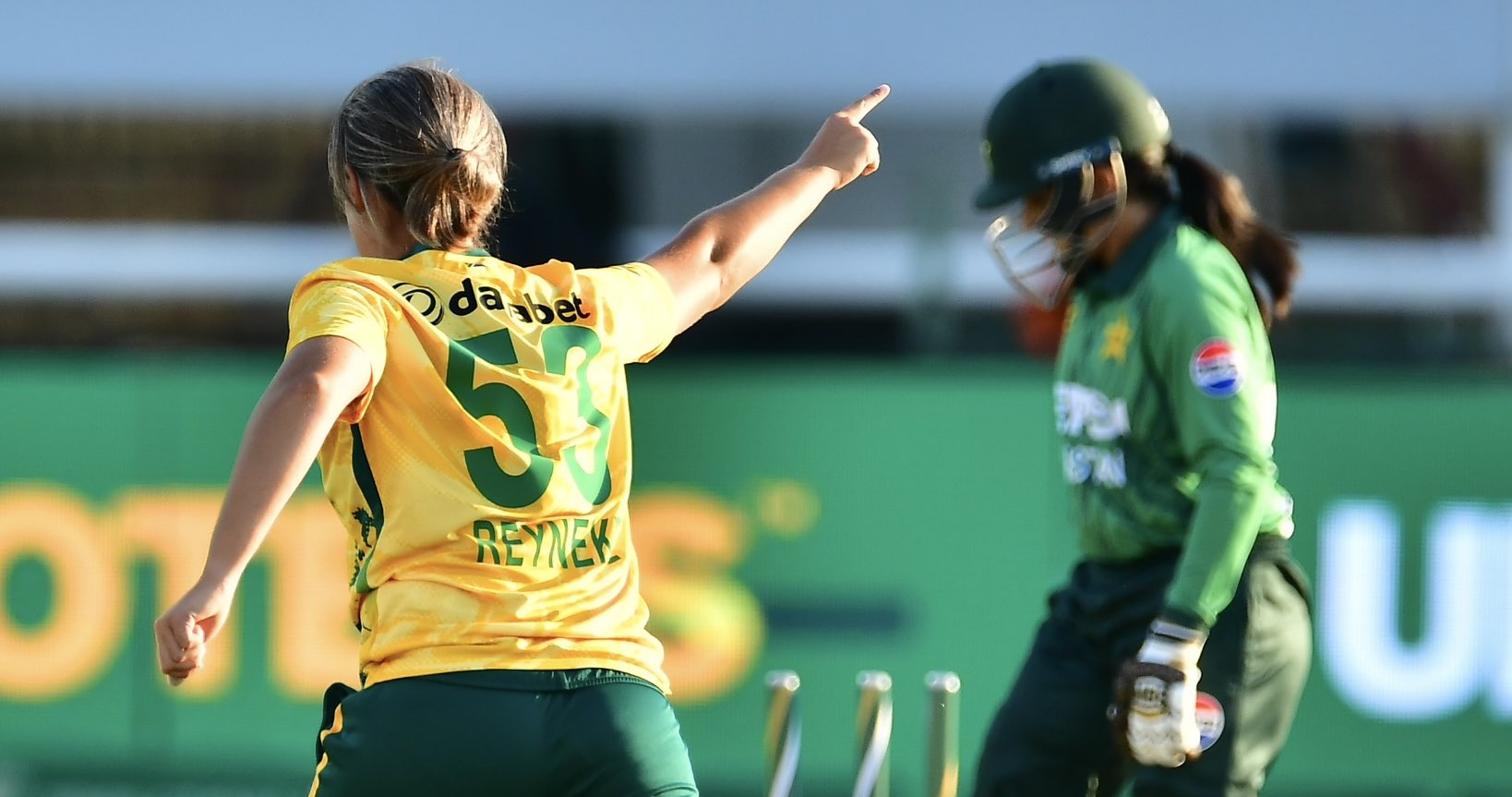
South Africa Women edged past Pakistan Women in a last-ball thriller to win the opening T20I by five wickets at Senwes Park, Potchefstroom, taking an early 1-0 lead in the series.
In a high-octane contest, the Proteas held their nerve to chase down a challenging target of 181 on the final delivery of the match. Despite a sensational individual performance from Pakistan’s Fatima Sana, South Africa’s composure under pressure ultimately proved decisive.
Pakistan’s innings began on a shaky note, with the visitors slipping to 46/3 during the Powerplay. The momentum shifted in the middle overs thanks largely to a blistering knock from Sana, who struck 90 off just 41 balls. She reached her half-century in only 27 deliveries, peppering the boundary with four fours and five sixes. Sana shared a vital 50-run partnership with Umm-e-Hani to stabilise the innings, guiding Pakistan past the 100-run mark in the 15th over before lifting her side to a competitive 180/9 from their allotted 20 overs.
South Africa’s reply was positive from the outset as they raced to 54/1 in the Powerplay. Captain Laura Wolvaardt led from the front with a composed 61 off 38 balls, anchoring the chase with authority. Her partnership with Sune Luus kept the required rate in check, with the Proteas bringing up their century in the 10th over.
The tension rose sharply in the death overs. South Africa crossed 150 in the 17th over, but tight bowling and smart use of reviews by Pakistan in the 18th and 19th overs slowed the scoring. With the match hanging in the balance in the final over, Kayla Reyneke (29* off 16) and Annerie Dercksen (9* off 9) showed great composure to scramble the required runs. In a dramatic finish, the hosts sealed victory off the final ball to end on 185/5.
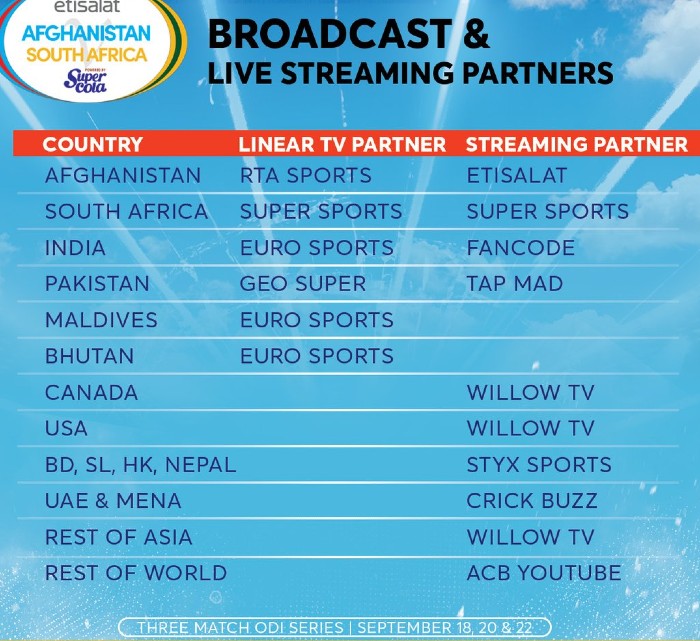
Here are the official TV partners/broadcasters for the Afghanistan vs South Africa national cricket team ODI series that begins in the United Arab Emirates on 18 September, 2024.
In India, Afghanistan vs South Africa can be watched on the Eurosport TV channel, with the online streaming rights with Fancode. In South Africa, it will be telecast on Supersport while in Pakistan, the broadcast rights are with Geo/Tapmad.
This AFG v SA clash is a three match series, with all three One Day Internationals set to take place in Sharjah (UAE)
If you’re not in one of the countries mentioned below, the September 2024 Afghanistan vs SA ODI series will also be streamed on the ACB Youtube page.
Eurosport India promo banner for AFG v SA cricket September 2024
West Indies 196 for 6 (Rutherford 76*, Chase 34; Rashid 2-16) beat England 166 all out (Curran 43*, Bethell 33; Motie 3-33) by 30 runs
A half-century from Sherfane Rutherford and a surprisingly electric display of spin bowling earned the West Indies a 30-run win over England in their ICC T20 World Cup Group C clash at the Wankhede Stadium on Wednesday.
They found themselves in early trouble after being sent to bat when Captain Shai Hope lashed at a short, wide one from fellow Barbadian Jofra Archer and was caught at cover for a 3-ball duck. Brandon King (1) then fell two balls later, taken in the deep off Sam Curran, leaving West Indies 8 for 2 in the 2nd over.
Roston Chase and the in-form Shimron Hetmyer countered with a 47-run third-wicket partnership. Chase, who was brought into the side as a replacement for Matthew Forde, got going with three consecutive fours off the off-spin of Will Jacks in the 4th before Hetmyer finished the over with a maximum.
Hetmyer’s 12-ball 23 ended when he was undone by the extra bounce of Jamie Overton, which gave England the upper hand at the end of the powerplay, with the West Indies 55 for 3.
While Chase (34) fell lbw to an Adil Rashid (2/16) googly in the 10th, Sherfane Rutherford opted for a measured start, scoring 10 from his first 13 deliveries. His first attacking shots were back-to-back sixes off Jacks in the 12th.
Rutherford and Rovman Powell got the innings back on track, putting on 51 from 29 balls for the 5th wicket. The pair teamed up for 17 runs from Archer’s 13th before Powell (14) was caught trying to take on Rashid in the 15th with the West Indies 128 for 5.
Jason Holder came and laid into Curran, smashing three maximums in the 17th on his way to a 17-ball 33. Holder and Rutherford reinjected momentum into the innings, smashing 61 from their 32 balls together at the crease.
When the former fell in the 19th, it left the unbeaten Rutherford (76 from 42) to put the finishing touches on the innings and get the West Indies up to 196 for 6 from their 20 overs.
England’s cracking start to the chase came courtesy of Phil Salt, who took Holder for 3 fours and 2 sixes in the 2nd over. He was sent back by Romario Shepherd for a 14-ball 30 in the 4th. Salt’s was the only wicket England lost in the powerplay, motoring on with Jacob Bethell, who joined Jos Buttler to end that phase with 67 runs on the board.
The pair put on 36 from 20 balls before Chase accounted for Buttler (21) to leave England 74 for 2 in the 7th. Gudakesh Motie (3/33) then took charge of proceedings, removing Tom Banton (2) in the following over before ripping through Jacob Bethell (33) with his variation of leg spin. At that, England were restricted to 90 for 4 in the 10th.
The Three Lions managed only 14 runs between overs nine and eleven, but the danger for the West Indies remained with skipper Harry Brook at the crease. Fortunately for the Caribbean side, a few sprinkles of the Motie magic also remained. And the Guyanese had Brook caught and bowled for 17 to leave England 131 for 5, needing 66 from the final 36 balls.
Chase (2/91) and Akeal Hosein followed up with the wickets of Jacks (2) and Overton (5) in the 15th and 16th overs, with England needing to score 14 runs per over in the final 4. Wickets continued to tumble until they were eventually dismissed for 166 in 19 overs, sending the West Indies to the top of Group C with two wins from two games.
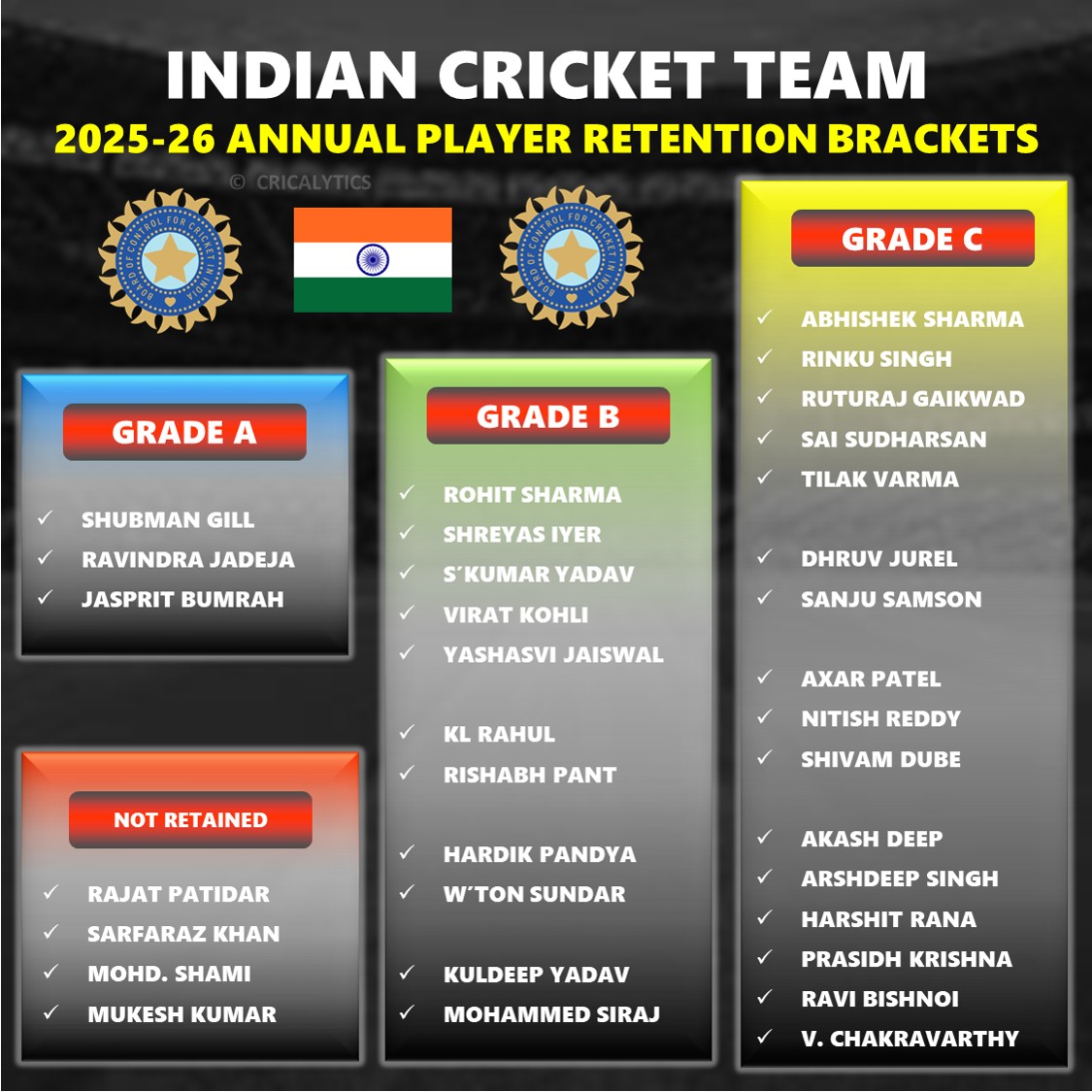
With Shubman Gill and Jasprit Bumrah in top tier, discover the 2025-26 full annual salary contract retention for Team India players for AY 2026.
The Board of Control for Cricket in India (BCCI) recently announced the annual player retainership for AY 2025-26. A total of 30 players have been given the contract, which runs from October 1st, 2025 to September 30th, 2026. Unlike the previous years where A+ was added as a retainer Grade, this year onwards only three grades have been added – A, B and C. This is similar to what the Women’s team has.
But if we observe the bifurcation closely, the BCCI seems to have given the weightage as per the format, and the number of formats each player is playing. As has been the case for the last few years, Tests have been given the highest importance, followed by ODIs, and then T20Is. So, if someone plays only Tests and ODIs, they would at least fall in Grade B. But if someone plays both Tests and ODIs, they would fall in Grade A. However, if someone plays only T20Is, they most likely fall in Grade C.
The BCCI made one important change in their annual player retentions, and that is removing the A+ category bracket, which earlier had four players. After the retirement of Virat Kohli and Rohit Sharma from Test and T20I formats, the BCCI doesn’t feel a need to have an A+ category, where, practically, we have only one all-format player, Jasprit Bumrah. So, instead of A+, the grades now start from A. Another important change that BCCI hasn’t disclosed is the contract price. Earlier, the brackets were 7 Cr, 5 Cr, 3 Cr, and 1 Cr, respectively. But now the brackets are changed, and BCCI hasn’t disclosed the annual retainer price.
Team India Players Annual Salary Contract for AY 2026
Grade A
Jasprit Bumrah
Ravindra Jadeja
Shubman Gill
With Grade A now the new top grade, it includes three players, and those are Jasprit Bumrah, Shubman Gill, and Ravindra Jadeja. Shubman Gill, who now leads the Test and ODIs team, and is also a part of the T20I squad sometimes, has been given the highest grade for a player. Jasprit Bumrah remains the only all-format player in this list. Whereas Ravindra Jadeja now plays two formats, and with him in grade A, it is expected that he will also be a part of the ODI setup of the 2027 World Cup.
Grade B
Batters
Rohit Sharma
Shreyas Iyer
Suryakumar Yadav
Virat Kohli
Yashasvi Jaiswal
Wicketkeepers
All-Rounders
Hardik Pandya
Washington Sundar
Bowlers
Kuldeep Yadav
Mohammed Siraj
Grade B includes 11 players, and it is a mix of dual-format players and those who play only ODIs. Rohit Sharma, Shreyas Iyer, and Virat Kohli are the ones who only play ODIs currently, and hence, they are placed in Grade B. Aside from ShRoKo, an exception has been made for Suryakumar Yadav, who plays only the T20I format, but since he is the Captain of the T20I team, he has been placed there. Barring these four, all other plays at least two formats, with Kuldeep and Sundar playing all three formats sometimes.
Grade C
Batters
Abhishek Sharma
Rinku Singh
Ruturaj Gaikwad
Sai Sudharsan
Tilak Varma
Wicketkeepers
All-Rounders
Axar Patel
Nitish Reddy
Shivam Dube
Bowlers
Akash Deep
Arshdeep Singh
Harshit Rana
Prasidh Krishna
Ravi Bishnoi
Varun Chakravarthy
Grade C includes a total of 16 players, and these are the players who are either emerging, or are playing just 1 format. So, among emergig players who play more than one format, we have Harshit Rana, Nitish Reddy, Prasidh Krishna, Arshdeep SIngh, and Dhruv Jurel. Whereas all other players play just one format, and that’s mostly T20Is. Interestingly, the list doesn’t include Ishan Kishan, and that’s because has has just made a comeback to the T20I side.
Not Retained
Rajat Patidar
Sarfaraz Khan
Mohammed Shami
Mukesh Kumar
Team India Players Annual Salary Contract for AY 2026 – Women Team
Grade A
Deepti Sharma
Harmanpreet Kaur
Jemimah Rodrigues
Smriti Mandhana
B Grade
Renuka Thakur
Richa Ghosh
Shafali Verma
Sneh Rana
Grade C
Amanjot Kaur
Arundhati Reddy
G Kamalini
Harleen Deol
Kashvee Gautam
Kranti Goud
Pratika Rawal
Radha Yadav
Sree Charani
Tejal Hasabnis
Uma Chetry
Vaishnavi Sharma
Yastika Bhatia
Thanks for reading! What’s your take on the official salary of the Indian Cricket team players for AY 2026? Please email your thoughts to business@cricalytics.com
ALSO READ: T20 World Cup 2026 Each Team Best Bowling Attack Ranking
You’d think I’d learn. That I would learn that England’s test team would always have done this. It’s not unprecedented. Put themselves in a decent spot, and then go down in flames. I kept harking back to Brisbane 1990 – where we got skittled, we skittled them for an unexpected lead, but instead of consolidating, we flumped again, and Aussie won by 10 wickets.
Truth is, it feels as the quality of the oppo goes up, the more we need the experienced pros to step up with the bat. Stokes and Root mainly, but the rest have been in the side for a while now. We had the best all round opener in the world in the summer (Ben Duckett, and he never was that), we have the prodigal plonker in next captain Harry Brook (I mean, seriously, how could you follow a bloke that bats the way he does) and by far the best player in county cricket in Ollie Pope, except he isn’t even that any more. And seriously, if Jacob Bethell is the answer, it’s a pretty daft question. I am just going to ignore Zak Crawley at this point, because the Aussie scoreboard did.
Not watched a ball today, and as soon as we didn’t get Travis Head early, England were done for. We all, in our heart of hearts, knew this was going to happen. Hope is not a strategy. Getting lucky twice is not a game plan. It might come off once on this tour, this might even have been it “coming off” for at least one madcap day, and lord did it get the Aussies worried (they are all being ever so cocksure today, but they were worried) but in the end, cricketing gravity worked itself out. This does feel like two bald fellas arguing over a comb, except they are high on meth, roided up and drinking Red Bull by the gallon.